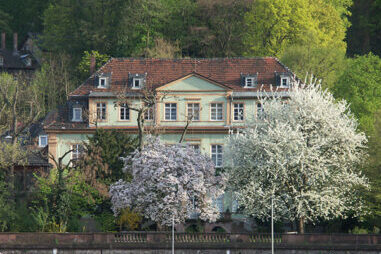
The Völkerkundemuseum vPST (Ethnographic Museum) at Palais Weimar in Heidelberg dates back to 1921, with its first exhibition opening in 1924.
The Collections
The museum’s collections encompass artworks and ethnographic objects from Asia, Africa, and Oceania. Through rotating exhibitions, we present diverse aspects of art and culture from these regions based on selected themes. In the 1980s, the main building was expanded with a modern annex. Additionally, the museum’s boat collection is on display in the arcades at Neckarmünzplatz.
The Location: Palais Weimar
The home of both the foundation and the museum is the Palais Weimar, one of Heidelberg’s oldest town residences. Built around 1710, this baroque palace situated between the Hauptstraße and the Neckar River looks back on a rich and varied history. Named after its last owner, Prince Wilhelm of Saxe-Weimar-Eisenach, it was acquired in 1921 by the foundation’s founders, Victor Goldschmidt and Leontine Goldschmidt (née von Portheim), to house their diverse collections.
A Legacy of Patronage
As early as 1919, the couple established the J. & E. von Portheim-Stiftung für Wissenschaft und Kunst (Foundation for Science and Art) to permanently guarantee the research activities of the scientific institutions they had initiated. In doing so, they stand in the great tradition of Jewish patronage of the arts and sciences in Germany.
Survival and Renewal
Of the original institutions, only the Ethnographic Institute survived the Nazi era; it continues today as the Völkerkundemuseum. Despite the significant material and intangible damage inflicted on the foundation and its collections during the National Socialist period, the museum still possesses outstanding holdings. In addition to historical photographs and manuscripts, these include exquisite artworks and ethnographic objects from Asia, Africa, and Oceania, which have been expanded in recent decades through targeted purchases and generous donations. Today, these collections serve not only as the basis for our museum work but also as an essential resource for scholars from around the world.